
The Structure Fire Section should be completed for all structure fires. A structure is an assembly of materials forming a construction for occupancy or use to serve a specific purpose. This includes, but is not limited to, buildings, open platforms, bridges, roof assemblies over open storage or process areas, tents, air-supported structures, and grandstands. Users may also optionally complete the Fire Section for confined building fires (Incident Types 113–118), although it is not required.
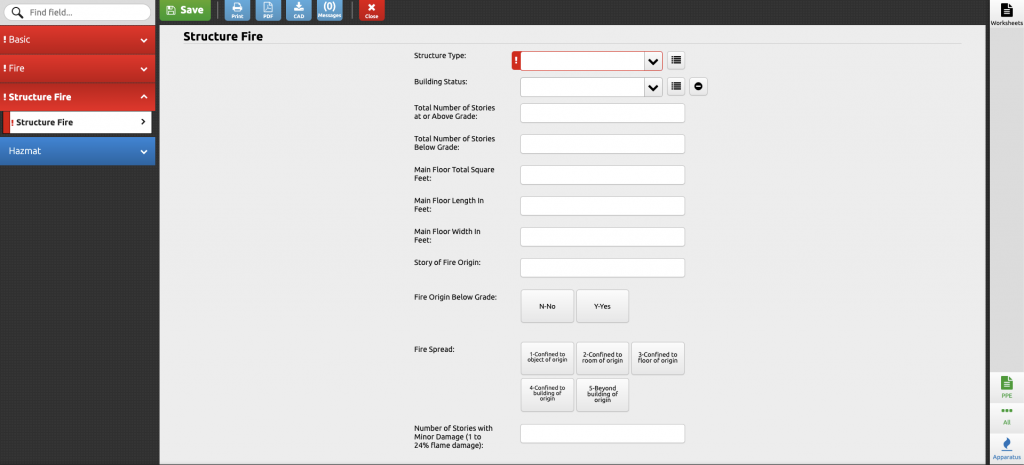
Structure Type – The identification of a structure as a specific property type. Choose the best option indicating the type of structure involved in the fire.
Building Status – The operational status of the building involved in the fire. This element indicates the actual use of the building at the time of the fire.
Total Number of Stories at or Above Grade – Enter the total number of stories at or above grade level. For split grades, consider the main egress point as the “at grade” portion of the building. Do not count normally inaccessible attics, attics with less than standing height, or the roof as a story
Total Number of Stories Below Grade – Enter the total number of stories below grade level.
Main Total Floor Square Footage – The size of the main floor in square feet. This is an estimate. Enter the total square footage of the main floor, or enter the area using length-by-width measurements (in feet). Do not enter both.
Main Floor Length in Feet – Enter the total square footage of the main floor, or enter the area using length-by-width measurements (in feet). Do not enter both.
Main Floor Width in Feet – Enter the total square footage of the main floor, or enter the area using length-by-width measurements (in feet). Do not enter both.
Story of Fire Origin – On which story of the building did the fire start.
Fire Origin Below Grade – Did the fire start in a basement or other floor that was below grade.
Fire Spread – The extent of fire spread in terms of how far the flame damage extended. The extent of flame damage is the area actually burned or charred and does not include the area receiving only heat, smoke, or water damage.
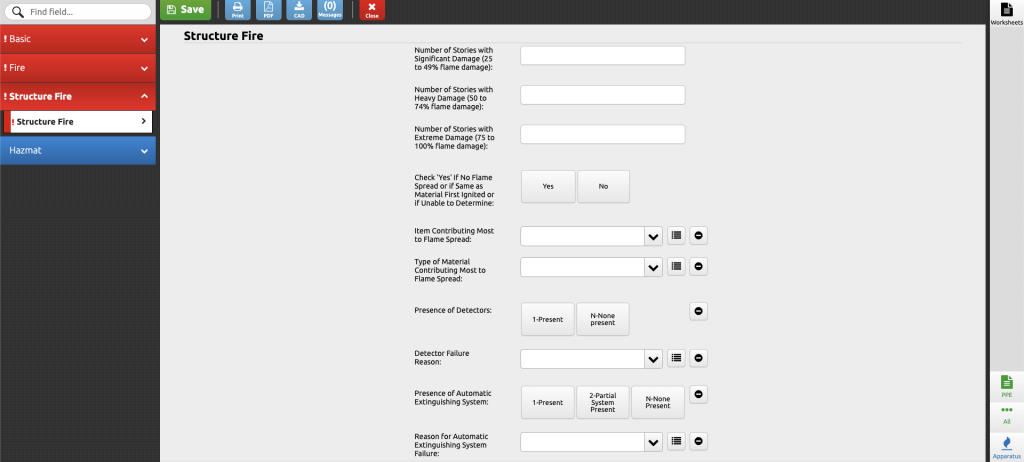
Item Contributing Most to Flame Spread – The item contributing most to flame spread, if different from the Item First Ignite.
Type of Material Contributing Most to Flame Spread – The type of material contributing most to flame spread, if different from the Type of Material First Ignited Skip this block if the material is unknown. Type of material refers to the raw, common, or natural state in which the material exists. The type of material may be a gas, flammable liquid, chemical, plastic, wood, paper, fabric, or any number of other materials.
Presence of Detectors – The existence of fire detection equipment.
Detector Failure Reason – The reason why the detector failed to operate or did not operate properly.
Presence of Automatic Extinguishing System – The existence of an automatic extinguishing system.
Reason for Automatic Extinguishing System Failure – The reason why the automatic extinguishing system failed to operate or did not operate properly.