
The Fire Section is completed for incidents involving a non-contained fire. Each panel in the Fire Section asks for information on particular types of fires or items involved in the fire.
Details
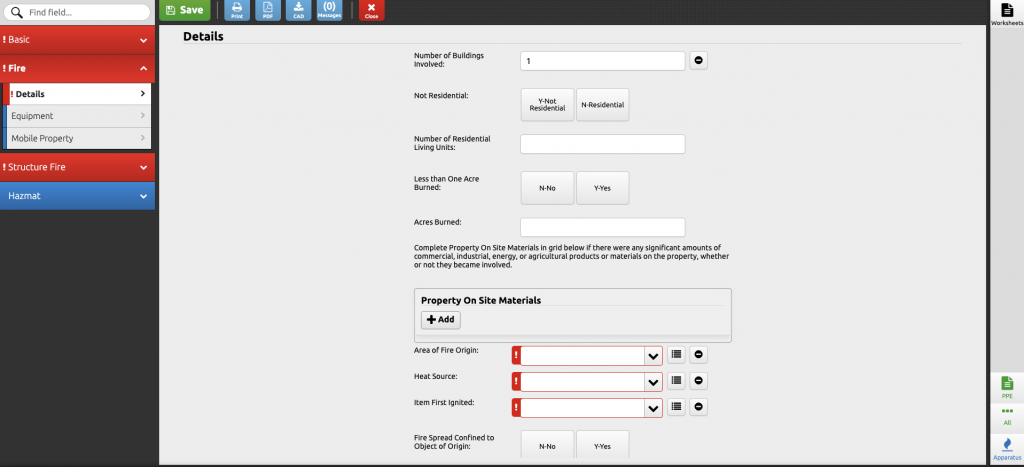
Number of Buildings Involved – The number of buildings directly involved in the fire. Each building involved in the fire should be documented as a separate exposure.
Not Residential – Is the building type residential or not.
Number of Residential Living Units – The estimated total number of residential living units in the building of origin, whether or not all of the units became involved in the fire. For example a fourplex has four living units, a duplex has two.
This information permits analysis of the fire problem by specific property use details. Information on the number of residential living units in the fire building provides a measure of the potential human exposure and can assist in targeting fire prevention and suppression programs.
Less than One Acre Burned – For natural cover fires was the total area burned less than 1 acre. One acre is 43,560 square feet or roughly the size of a football field excluding both end zones.
Acres Burned – The estimated number of acres burned in the fire incident. One acre is 43,560 square feet or roughly the size of a football field excluding both end zones.
Area of Fire Origin – The primary use of the area where the fire started within the property. The area of origin may be a room, a portion of a room, a vehicle, a portion of a vehicle, or an open area devoted to a specific use. Every fire has an area of fire origin.
For chimney fires, the area of fire origin is classified as the first area where ignition occurred. For example, if the chimney is associated with a fireplace in the family room, the code would be “14.” The chimney is considered the Equipment Involved in Ignition.
Heat Source – The heat source that ignited the Item First Ignited to cause the fire.
Item First Ignited – The use or configuration of the item or material first ignited by the heat source. This field identifies the first item that had sufficient volume or heat intensity to extend to uncontrolled or self-perpetuating fire.
Fire Spread Confined to Object of Origin – Was the fire limited to the object that originally began burning.
Property On Site Materials
Identifies any significant amounts of commercial, industrial, energy, or agricultural products or materials on the property, whether or not they became involved in the fire.This element permits analysis of the fire problem by the materials and products present on the property involved in the fire. Information on materials and products present can assist in targeting fire prevention and suppression programs and identifying training and equipment needs.
If a Property Use in the 500s, 600s, 700s, or 800s was listed in the Basic Panel, then this field is required.

Add Another – Saves current entry and creates a blank form to add another on site material.
Ok – Saves and closes the form.
Cancel – Closes the form without saving.
On-Site Material – Type of material.
On-Site Material Storage Use – Storage method of the material.
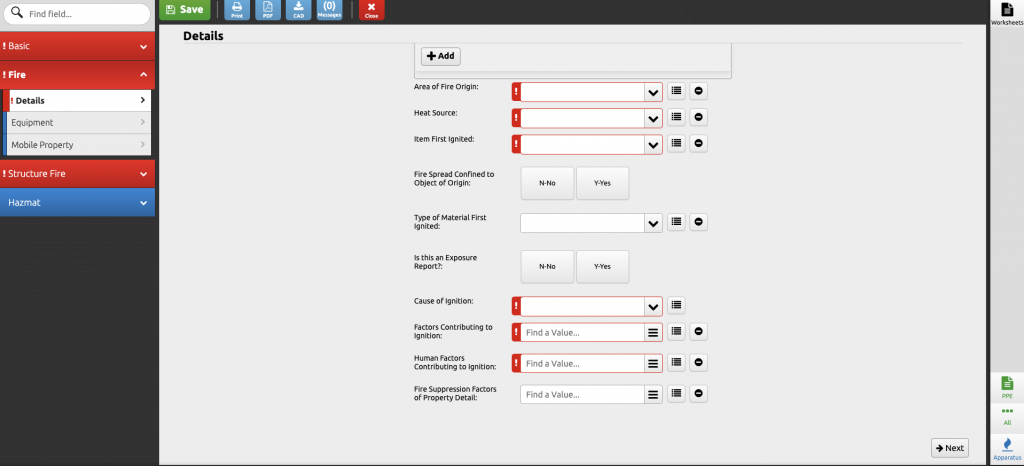
Type of Material First Ignited – The composition of the material in the item first ignited by the heat source. The type of material ignited refers to the raw, common, or natural state of the material. The type of material ignited may be a gas, flammable liquid, chemical, plastic, wood, paper, fabric, or any number of other materials.
Is this an Exposure Report – Is this report for a building or equipment other than the building of origin.
Cause of Ignition – The general causal factor that resulted in a heat source igniting a combustible material. The cause could be the result of a deliberate act, mechanical failure, or act of nature. This is the best determination of the firefighter at the scene and may be changed later as a result of further investigation or other information.
Factors Contributing to Ignition – Combined with Cause of Ignition and Human Factors Contribution to Ignition, this information explains how and why the fire started. It can also indicate whether a fire is potentially preventable through public education, code enforcement, or other strategies.
Human Factors Contributing to Ignition – The human condition or situation that allowed the heat source and combustible material to combine to ignite the fire.
Fire Suppression Factors of Property Detail – Factors that contributed to the growth, spread, or suppression of the fire. This is used to report incident information that directly impacted the ignition, spread of fire or smoke, incident complexity, or presence of hazardous conditions.
Example:
The first-due engine company was delayed due to “trouble finding location” (436) after incorrect information was given by the dispatcher.
Due to the instability of the “wood truss construction” (185) roof, firefighters halted their interior attack and went into a defensive strategy.
Equipment
The piece of equipment that provided the principal heat source to cause ignition. Analysis of the equipment involved in ignition is useful for improving product safety and preventive maintenance. It is just as important to know the kind of equipment that was used improperly as it is to know the kind of equipment that malfunctioned. Misuse can be the direct result of the way the equipment is designed and constructed. When involved in ignition, equipment information provides an important part of the causal data. Equipment involved in ignition can be compared to other causal data to determine if the equipment was (or was not) operating properly.
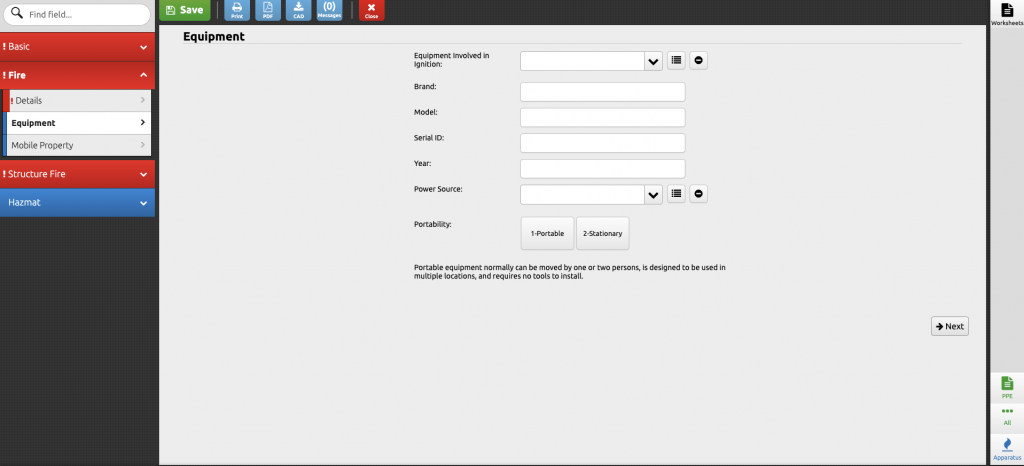
Equipment Involved in Ignition – What best describes the equipment involved in ignition.
Brand – The name by which the equipment is most commonly known.
Model – The model name or number assigned to the equipment by the manufacturer. If there is no specific model name or number, use the common physical description of the equipment.
Serial Number – The manufacturer’s serial number that is generally stamped on an identification plate on the equipment.
Year – The year that the equipment was built.
Power Source – The type of power used by the equipment involved in ignition of the fire. This does not include what actually produces the power.
Portability – Describes the equipment involved in ignition as either portable or stationary. Portable equipment normally can be moved by one or two persons, is designed to be used in multiple locations, and requires no tools to install.
Mobile Property
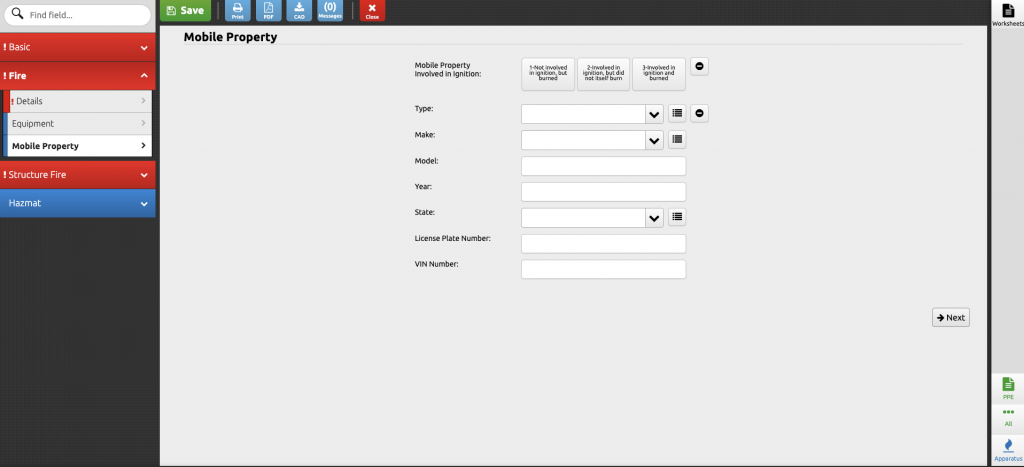
Mobile Property Involved in Ignition – This element is used to determine how mobile property relates to a fire (i.e., if involved in the ignition and whether or not it burned).
Type – Property that is designed and constructed to be mobile, movable under its own power, or towed, such as an airplane, automobile, boat, cargo trailer, farm vehicle, motorcycle, or recreational vehicle.
Make – The name of the manufacturer of the mobile property.
Model – The manufacturer’s model name. If one does not exist, use the physical description of the property that is commonly used to describe it, such as “three-bedroom” (mobile home) or “four-door” (sedan).
Year – The year the mobile property was manufactured.
State – The State in which the vehicle is licensed
License Plate Number – The number on the license plates affixed to the vehicle; plates are generally issued by a State agency of motor vehicles. License numbers may also be available for boats, airplanes, and farm vehicles.
VIN Number – The manufacturer’s Vehicle Identification Number that is generally stamped on an identification plate on the mobile property.